
The Iran MOU
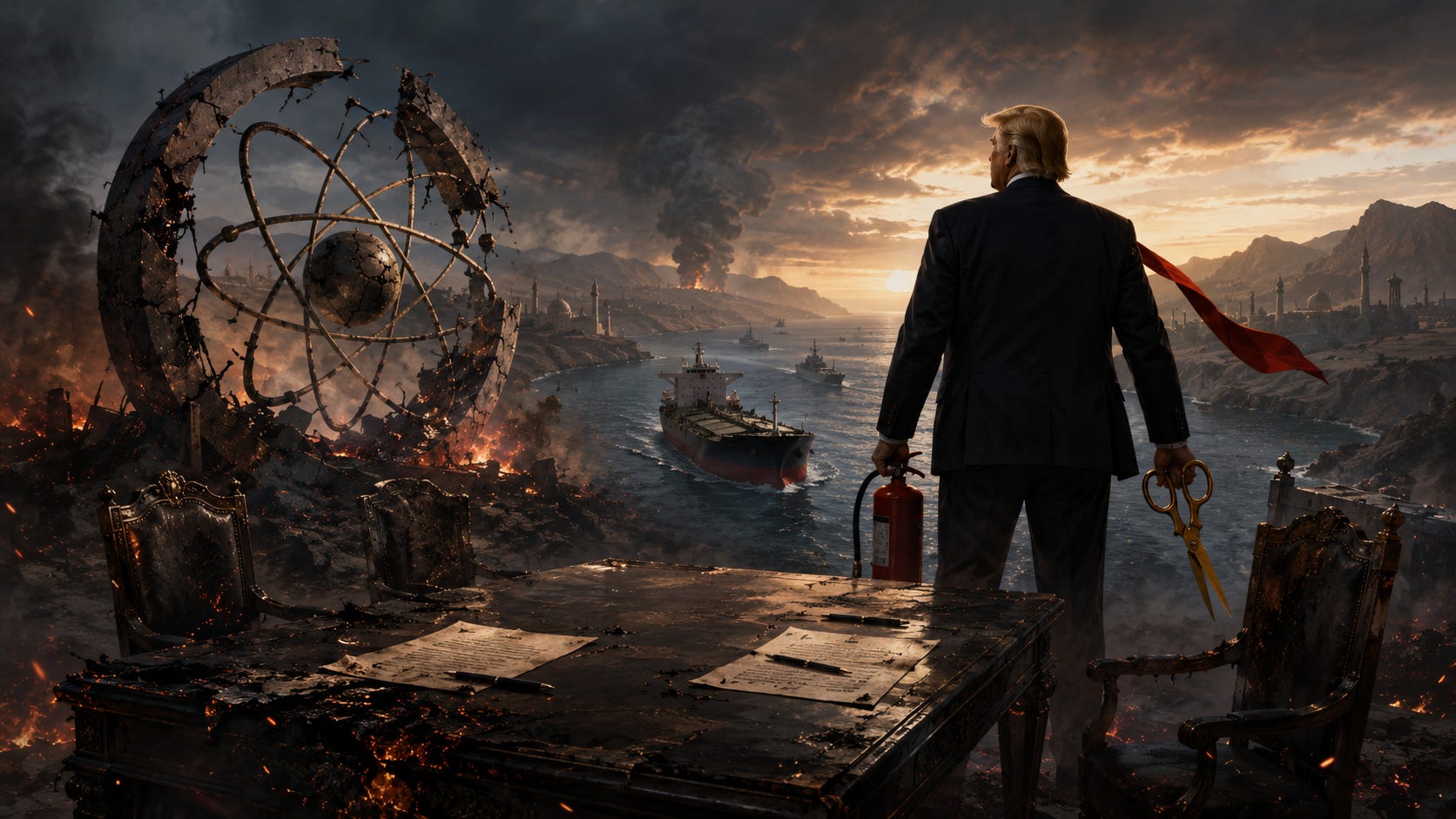
arson, followed by a ribbon-cutting at the firehouse

Introduction:
a Necessary Caveat Because Adults Still Exist
The new U.S.–Iran Memorandum of Understanding should be read with one eyebrow raised and the other armed.
It is not yet a final treaty. It is not a durable settlement. It is not the long-awaited conversion of Tehran into the Geneva Rotary Club. It is a preliminary instrument designed to stop a war, reopen a chokepoint, lower the temperature, and buy sixty days of diplomacy before the next catastrophe elbows its way into the room. The text declares an immediate and permanent end to military operations, including in Lebanon; commits both sides to negotiate a final deal within sixty days; provides for the removal of the U.S. naval blockade; opens a pathway for Iranian oil exports, frozen funds, sanctions relief, and reconstruction money; and has Iran reaffirm that it will not procure or develop nuclear weapons.
So let us begin with the obligatory act of civic sobriety: stopping a war is good.
There. Having performed the required genuflection before the altar of the obvious, we may now proceed to the scandal.
The scandal is not that America negotiated with Iran. Only children and cable-news colonels believe diplomacy with enemies is a Valentine. The scandal is that the same political movement that spent years denouncing the 2015 Iran nuclear agreement as a Munich in Persian costume has now discovered, after war, that sanctions relief can be exchanged for nuclear promises, that inspection regimes matter, that maritime chokepoints have economic consequences, and that Tehran does not disappear merely because one says “maximum pressure” into a microphone with sufficient baritone.
In 2018, President Trump terminated U.S. participation in the JCPOA and reimposed sanctions, arguing that the deal failed to protect American national-security interests. Now, after abandoning the old table, kicking over the chairs, setting fire to the curtains, and announcing the birth of a new doctrine, Washington appears to have returned to the building with a contractor’s estimate and called it statesmanship.
One is tempted to admire the audacity. One is more tempted to check the insurance policy.
ANNOUNCEMENT:
Threshold: A Nora Vasik Novel — Book One of The Cascade Series.
by Alex Horovitz
Twelve people died in four minutes at a geothermal plant in Iceland. The official explanation is plausible. It is also incomplete.
The Great Trumpian Circle:
From “Worst Deal Ever” to “Please Initial Here”
The 2015 Iran agreement was imperfect. This must be said because otherwise the tribal stenographers will start sharpening their crayons. The JCPOA had sunset clauses. It did not solve Iran’s missile program. It did not end Tehran’s regional adventurism. It depended on verification, enforcement, allied coordination, and the patience of presidents, which is rather like building a bridge out of porcelain and then inviting elephants to jog across it.
But the JCPOA had one virtue almost embarrassingly absent from our public debate: sequencing.
On Implementation Day in January 2016, the Treasury Department said sanctions relief followed IAEA verification that Iran had implemented key nuclear-related measures. That is not a minor procedural footnote. It is the whole moral architecture of coercive diplomacy: you do not pay the locksmith before he opens the door, much less while he is still insisting the door is a Zionist hallucination.
Now compare that to this MOU. The text says the U.S. Treasury will issue waivers for Iranian crude oil, petroleum products, derivatives, and associated banking, insurance, transportation, and other services immediately upon signing, until sanctions are terminated. Reuters and others are reporting likewise described the MOU as covering oil-sanctions waivers, reopening Hormuz, and future nuclear talks over the following sixty days.
That is the great inversion. The 2015 deal relieved sanctions after verified nuclear steps. This MOU appears to begin economic relief while the hardest nuclear questions are still wearing name tags at the opening reception.
And yet the sales pitch will be familiar. The administration will insist that this is not Obama’s Iran deal. Of course not. Obama’s deal was a diplomatic framework with sanctions relief. Trump’s deal is a diplomatic framework with sanctions relief, oil waivers, frozen funds, a reconstruction plan, a maritime bargain, and the faint aroma of cordite.
Completely different animal. One was a horse. This is a horse with Trump’s name painted on the saddle.
The War Bought Us a Calendar
The most damning question is not whether this MOU is better than continued war. It is. Most things are better than continued war. A dental abscess is better than continued war. A faculty-senate meeting is better than continued war (although only narrowly).
The real question is what the war achieved that could not have been achieved before the war.
The preliminary pact reportedly ends fighting and reopens the Strait of Hormuz, but leaves the fate of Iran’s nuclear program to further negotiations. That is a rather large “but.” It is not a wrinkle. It is the bedsheet. If the war was sold as the necessary instrument to end Iran’s nuclear threat, then a deal that postpones the decisive nuclear settlement is not victory. It is a ceasefire with better marketing.
The MOU says Iran reaffirms that it shall not procure or develop nuclear weapons. Good. It also says the parties will resolve the disposition of stockpiles and enriched material through a mechanism to be mutually agreed upon, with on-site down-blending under IAEA supervision as the minimum methodology. It further says enrichment and other nuclear needs will be discussed in the final deal.
Translated from diplomatic Esperanto: the most important questions remain unresolved.
Will Iran retain enrichment capacity? At what level? Under what inspection regime? With what consequences for violations? What happens to stockpiles? Who verifies? Who enforces? What does “status quo” mean if the status quo is the thing we just went to war over? These are not technicalities. These are the difference between a nuclear agreement and a scented candle.
The administration’s defenders will say: “But Iran has agreed not to build a bomb.”
Splendid. And I have agreed not to become the King of Sweden. The relevant question is not whether Tehran will recite a nonproliferation catechism. The relevant question is whether the agreement prevents Iran from standing perpetually at the threshold, wearing innocence like a rented tuxedo.
Lebanon, Hezbollah, and the Clause with Too Many Ghosts in It
Then comes the Lebanon language, which deserves its own small bell tower of alarm.
The MOU’s first paragraph includes the termination of military operations “on all fronts, including in Lebanon,” while also committing the parties not to initiate war or military operations against each other and to respect Lebanon’s territorial integrity and sovereignty. The Guardian reports that the agreement’s Lebanon component is understood as requiring Iran to restrain Hezbollah.
If that works, excellent. No decent person should prefer Lebanon to remain an arena in which outside powers conduct their experiments in deterrence using Lebanese civilians as laboratory glassware.
But there is the little matter of agency. Hezbollah is not a toaster Iran can unplug with a single ayatollah’s finger. It is a militia, political actor, patronage network, ideological project, and regional instrument. Tehran has influence. It does not have a remote control with fresh batteries and a clearly labeled “de-escalate” button.
A ceasefire that depends on the good behavior of armed proxies must be judged by the mechanisms that restrain them. The MOU gestures toward an executive mechanism to monitor implementation. Good. But “monitoring” is not enforcement. A thermometer does not cure malaria.
This is where foreign-policy rhetoric often commits its most extravagant fraud. It confuses the announcement of a structure with the existence of power. It imagines that because a sentence has been written, a militia has been tamed. That is the kind of thinking one expects from people who believe hashtags are institutions.
The $300 Billion Question:
Reconstruction, Development, or Very Expensive Face-Saving?
The MOU says the United States, with regional partners, will develop a mutually agreed plan of at least $300 billion for reconstruction and economic development in Iran, with the mechanism to be finalized in the final deal.
At least $300 billion.
There are smaller numbers in astronomy.
Now, perhaps this is not American taxpayer money. Perhaps regional partners pay. Perhaps it is investment, credit, guarantees, escrowed mechanisms, oil-backed development, or some other financial centaur produced by the mating habits of sovereign wealth funds and diplomatic euphemism. Reporting has noted that Trump says the U.S. will not contribute directly and that the package appears tied to progress in later negotiations.
Still, the optics are not subtle. After years of insisting that Iran would be crushed by pressure, Washington is now helping design the reconstruction of the country it just fought. If this is victory, it has an unusual resemblance to a settlement check.
The administration’s line will be that Iran receives benefits only if it complies. Perhaps. But politics is not litigated in footnotes. In Tehran, the regime will say: we endured American force and emerged with oil waivers, assets, sanctions talks, maritime recognition, and a reconstruction package. In Washington, Trump will say: I ended the war and got Iran to promise no bomb. In reality, both sides may be conducting a little theater for domestic consumption, each hoping its audience is too exhausted to read paragraph eight.
That is the trouble with performative foreign policy. Eventually the performance becomes the policy.
Maximum Pressure, Maximum Irony
The Trump doctrine toward Iran was advertised with the simplicity of a bumper sticker and the intellectual depth of one. Maximum pressure. Better deal. No appeasement. Strength. Deterrence. The usual muscular nouns, flexed before cameras like underfed bodybuilders.
Yet here we are.
The old deal was supposedly intolerable because it gave Iran economic relief in exchange for nuclear constraints. The new framework contemplates oil waivers, frozen funds, sanctions termination, reconstruction money, blockade relief, and future nuclear negotiations.
The old deal was supposedly too temporary. The new MOU buys sixty days.
The old deal supposedly failed because it did not cure Iran’s regional behavior. The new MOU tries to fold Lebanon into a ceasefire and hopes Iran can restrain its proxies.
The old deal was supposedly weak because it relied on verification. The new MOU also relies on IAEA supervision and an executive monitoring mechanism.
The old deal was derided as naïve for trusting Iran. The new MOU trusts Iran to maintain the nuclear status quo, facilitate safe shipping, negotiate stockpile disposition, and participate in a final agreement.
Forgive the vulgarity, but this is not a doctrine. It is a boomerang with a press secretary.
The point is not that Obama was a saint or Trump a fool in every respect. The point is that policy must be judged by consequences, not adjectives. If the JCPOA was flawed, the answer was to improve it, extend it, enforce it, or build a better coalition to replace it. The answer was not to abandon it, escalate the crisis, stumble into war, and then return with a more expensive imitation wearing a red tie.
This is the foreign-policy equivalent of smashing your neighbor’s window, selling him plywood, and calling yourself a housing innovator.
Conclusion:
What You Should Say
So what should one say about the new MOU?
Say this:
It is good that the war is ending. It is good that ships may again move through Hormuz. It is good that nuclear questions are back inside a diplomatic process rather than being answered by pilots, missiles, and undertakers.
But it is not a triumph. It is an indictment.
It indicts the fantasy that America can withdraw from imperfect agreements without paying the cost of the vacuum it creates. It indicts the juvenile belief that sanctions are a policy rather than a tool. It indicts the habit of treating “strength” as a substitute for sequencing, verification, and allied discipline. It indicts the idea that smashing diplomacy proves toughness, when very often it merely guarantees that the next negotiation begins amid smoke, inflation, and widows.
Say that the MOU should be supported only insofar as it verifiably reduces the danger of war and the danger of a nuclear Iran. Say that oil waivers and asset access must be tied to measurable nuclear concessions, not to atmospherics, handshakes, or the narcotic glow of presidential self-congratulation. Say that any final deal must answer the questions this MOU postpones: enrichment, stockpiles, inspections, snapback, proxies, missiles, maritime access, and enforcement.
Say that Congress should not behave like a kennel of partisan spaniels, barking or rolling over according to whether the man holding the leash has the correct party label. Republicans who called the JCPOA appeasement owe the public an explanation for why this is not appeasement with worse sequencing. Democrats who defended the JCPOA should resist the temptation to call this deal vindication without first asking whether its verification architecture is strong enough. The standard must be reality, not team merchandise.
And say, finally, that Trump’s Iran policy has become the perfect monument to American amnesia: abandon the agreement, denounce the diplomats, escalate the pressure, fight the war, reopen the negotiations, repackage the concessions, and declare victory over the problem one helped recreate.
The MOU may stop the bleeding. Good. Stop it.
But do not let the arsonist sell us the fire extinguisher as a miracle of original invention.