
R.I.P. Alan Greenspan
The Maestro Who Mistook the Bubble for the Music

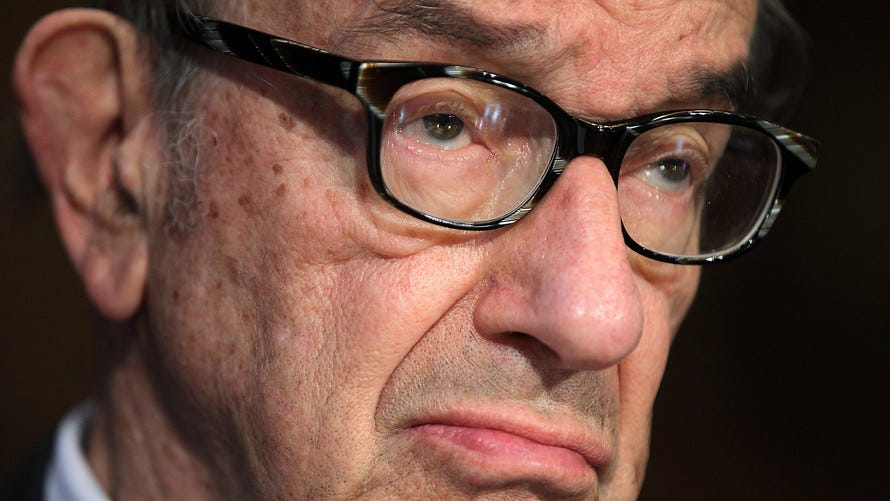
Alan Greenspan is dead at 100. And so, perhaps, is one more small portion of the 20th century’s great superstition: that if only the right man sat behind the right mahogany desk, with the right briefcase, the right eyebrow, and the right Delphic aversion to ordinary English, the economy might be conducted like a symphony rather than endured like weather.
He was, by all accounts, a man of formidable intellect, odd charm, monastic discipline, and almost comic incongruity: a Juilliard-trained clarinetist, a baseball-statistics obsessive, an Ayn Rand intimate, a bathtub reader of economic reports, a Wall Street oracle, and finally the nearest thing democratic capitalism has produced to a philosopher-king with a discount window. Greenspan died yestrerday, June 22 at age 100, after complications from Parkinson’s disease. The world notes that his nearly 19-year reign at the Federal Reserve made him “the world’s most powerful central banker” of modern times.
The old nickname was “Maestro,” which was both tribute and indictment. A maestro, after all, is meant to read the score. Greenspan too often mistook the audience’s applause for the music.
He became chairman of the Federal Reserve in 1987, just in time for Black Monday, and he responded with admirable speed. Markets trembled; the central bank supplied assurance; civilization, or at least the equity market, resumed breathing. Thus began the Greenspan legend: the quiet man with the murmured phrase, the financial shaman whose syntax alone could move continents. CNBC reportedly watched the thickness of his briefcase as if it were the liver of a sacrificial goat. Analysts parsed his commas. Congressmen queued up not for answers but for benedictions. If he spoke clearly, he himself joked, he had been misunderstood.
This was amusing until one remembered that the joke was on our republic.
For here was the strange constitutional development of the Greenspan era: a free people, noisily suspicious of every school board and zoning committee, came to accept that a committee of economists could divine the proper price of money. We would not trust twelve experts to select the national sandwich, but we entrusted them with the pulse rate of credit. Greenspan did not invent this presumption, but he personified it magnificently. He made central banking glamorous, which is rather like making embalming athletic.
His achievements were real. The Great Moderation was not a mirage merely because the desert later swallowed several subdivisions. Inflation remained low, growth was steady, recessions were mild, and unemployment during his tenure averaged lower than in the two decades before it. He guided the country through the 1987 crash, the 1991 recession, emerging-market panics, the dot-com bust, and September 11. These are not footnotes. They are a career.
But the obituary cannot stop there unless it wishes to become stenography with flowers.
Greenspan’s central error was not that he believed in markets. That, in Washington, is almost a venial sin. His error was subtler and more expensive: he believed markets would police themselves at precisely the moment when policy had trained them to expect rescue. He preached discipline while inventing indulgence. The famous “Greenspan Put” was not a policy printed in the Federal Register; it was a theology absorbed by traders. Risk, properly socialized, became adventure without consequence. Wall Street discovered that moral hazard could wear a green eyeshade and speak in complete dependent clauses.
The results were visible to anyone not professionally obligated to miss them. We note that household debt rose from 53 percent to 82 percent of the economy during his tenure, that ultra-low rates from 2003 to 2005 helped inflate the housing mania, and that the Fed under Greenspan took a largely hands-off approach toward a financial system growing more baroque, leveraged, and combustible. He warned of “irrational exuberance,” then stood aside while exuberance acquired a mortgage broker, a derivatives desk, and a vacation condo in Phoenix. He saw “froth” in housing, which was rather like seeing “moisture” on the deck of the Titanic.
And here we approach the delicious paradox of the man. Greenspan, disciple of Rand, apostle of markets, was also the high priest of the most powerful economic planning apparatus in American life. He was a libertarian who governed the price of money. One imagines Ayn Rand looking down from whatever Objectivist balcony eternity provides and muttering: “Alan, darling, this was not quite what I meant.”
Yet the target cannot be Greenspan alone. Indeed, to make him the sole villain would be to commit the very error he committed: attributing to one man more knowledge and power than any one man can possibly possess. The true scandal is institutional. The Federal Reserve, like all priesthoods, survives by ritualizing uncertainty. It dresses guesses as models, delays as prudence, reversals as flexibility, and errors as data-dependent learning. Its officials are forever peering into the economy as if into a microscope, forgetting that the object under inspection is also watching them, borrowing against them, front-running them, and occasionally laughing at them.
Central banking is necessary, or so I am told. But necessity is not divinity. A fire department is necessary; one does not therefore ask the fire chief to design the city’s architecture, appraise everyone’s furniture, and decide the correct temperature of ambition.
Greenspan’s final tragedy was that he lived long enough to see the halo tarnish. In 2008, he acknowledged that his assumptions about the self-interest of banks had failed him. That admission was honorable. It was also late. By then the “solid edifice” had cracked, and the bill had migrated, as bills in Washington invariably do, from the confident to the innocent. The world discovered that the Maestro’s baton had been conducting not only productivity and prosperity, but leverage, opacity, and a great national hallucination in which house prices ascended like souls and risk disappeared because clever men had renamed it.
Still, let us not be crude. Greenspan was no fool. Quite the opposite: he was a brilliant man whose brilliance helped conceal the limits of brilliance. He had the private-sector knowledge of a consulting savant, the Washington instincts of a courtier, the analytical appetite of a monk, and the prose style of a man trying to communicate with submarines. He was at once impressive and cautionary. The error was not that America listened to him. The error was that America listened as though economic truth had finally agreed to testify before Congress.
So we bury Alan Greenspan with the respect due a consequential public servant and the skepticism due a consequential public servant. He was serious, learned, diligent, and frequently right. But when he was wrong, he was wrong at scale. That is the problem with central banking as metaphysics: the mistakes are not private. They are syndicated.
Perhaps the final judgment is this: Alan Greenspan mastered the instruments of monetary policy, but not the humility those instruments require. He knew more about boxcar loadings, productivity trends, mortgage flows, and the vascular system of American commerce than almost anyone alive. Yet the great question escaped him because it escapes all mandarins eventually: what if the system is not a machine to be tuned, but a civilization to be restrained from believing too much in its tuners?
The Maestro is gone. The orchestra remains. And somewhere, in a conference room upholstered against doubt, the next committee is already clearing its throat.
“Choice” - Spencer to Kate - a quality, unique in substance and style, like this essay.