
After Fairness
our Republic in the age of the feed


The Old Doctrine and the New Disorder
The Fairness Doctrine died in 1987, and like many deaths in Washington, it has enjoyed a remarkably noisy afterlife.
Its mourners remember it as a kind of lost civic sheriff, standing at the saloon door of American broadcasting, insisting that controversial issues be treated with some attention to opposing views. Its detractors remember it as a bureaucratic busybody with a badge, empowered to ask whether the citizen had received the properly balanced ration of public affairs. Both memories contain a little truth, which is more than can be said for most memories in politics.
The doctrine belonged to the broadcast age. An age of scarcity. A world of scarce spectrum, licensed stations, three-network habits (unless your parents were professors or you lived in a college town; in which case you always had a fourth), local gatekeepers, and a public that encountered national affairs through institutions that still had addresses, switchboards, editors, and some residual fear of embarrassment. It was not an age of perfect seriousness. Let us not become sentimental. The old media world could be arrogant, clubby, dishonest, incurious, class-bound, and spectacularly wrong. But it did possess one virtue now almost exotic: it could be found. There was an editor, a station, a publisher, a license, a building, a masthead, a correction policy, a local reputation to be injured.
The Fairness Doctrine was repealed because it sat very uneasily (some might say not at all) with the First Amendment and because the scarcity rationale was already weakening. Cable was rising. Radio was multiplying. The information world seemed to be expanding. Why should Washington instruct broadcasters in the etiquette of balance when the citizen could simply turn the dial?
Then history, with its usual sadistic timing, supplied the dial with not just with 11, but with infinity.
Today the citizen does not merely turn the dial. We are through the looking glass. The dial turns the citizen. News arrives not as a broadcast but as weather: algorithmic, ambient, emotional, customized, monetized, and usually accompanied by someone insisting that every decent person should already know what to think. The old broadcaster sought an audience. The new feed manufactures one, studies it, enrages it, sells it, and calls the process engagement.
This is our post fairness world: not censorship, exactly; not liberty, exactly; but a kind of cheap mass hallucination available by subscription, push alert, podcast, livestream, short video, anonymous account, patriotic merchandise, and dietary supplement.
The censors of old at least had the courtesy to wear uniforms. The modern propagandist wears “authenticity.”
Abundance Was Not the Same as Pluralism
The great mistake of late twentieth-century media optimism was to confuse abundance with pluralism. Ted did it first. Zuck did it again.
Abundance means more. More channels, more voices, more shows, more feeds, more links, more platforms, more newsletters, more podcasts, more influencers, more people shouting “do your own research” into devices built by engineers whose business model depends on no one doing anything of the kind.
Aside: “Do your own research” sounds like intellectual independence, but in the Rauch-Popper view it is nearly an oxymoron. Truth is not what the solitary mind extracts from the internet after an evening among tabs; it is what survives public criticism, institutional checking, adversarial testing, correction, replication, and the embarrassment of being answered by people who know things you do not. Popper’s insight was that knowledge advances by conjecture and refutation, not private certainty; Rauch’s view of science extends that into a social system where no one gets the final word, but everyone’s claim must face the discipline of others. To “do your own research,” in the populist sense, is often to flee that discipline while borrowing its costume. It replaces the laboratory, the editor, the peer, the archive, the court record, the correction, and the rival expert with a browser history and a mood. It is not research. It is self-ratification with footnotes.
Pluralism is different. Pluralism requires institutions, habits, trust, rival authorities, shared rules, local knowledge, and the possibility of correction. Pluralism means that one may hear more than one voice and have some way to judge whether any of them is attached to reality. Abundance gives the citizen a thousand doors. Pluralism gives the citizen a map, a town, a library, a paper, a neighbor, a church basement, a union hall, a school board meeting, a local reporter, a public record, and someone who can say, “No, that is not what happened here.”
We got the doors. We misplaced the town.
The result is not merely misinformation, though there is plenty of that, stacked high and sold wholesale. The deeper problem is disembedded information. A national rumor lands in a local mind before local reality has put on its shoes. A video from nowhere becomes proof of everywhere. A school-board clip becomes a theory of civilization. A crime story becomes a migration policy. A campus tantrum becomes a verdict on an entire generation. A drag performance in one city becomes a national emergency for people who cannot name their county commissioners.
The modern citizen is drowning in information and starving for context.
That is why the repeal of the Fairness Doctrine cannot be undone by nostalgia. To restore it now would be to bring a butter knife to a drone war. The old doctrine was designed for licensed broadcasters. The modern disorder lives in cable, podcasts, TikTok, YouTube, X, Facebook, Instagram, newsletters, group chats, search engines, recommendation systems, AI slop, anonymous accounts, synthetic images, foreign influence shops, domestic grifters, and the middle-aged uncle who now believes himself a geopolitical analyst because he has discovered a man with sunglasses and a microphone.
A federal balance rule cannot govern this without becoming either useless or tyrannical. Useless if narrow. Tyrannical if broad. The moment Washington decides which views must be “balanced,” the battle shifts from persuasion to capture. Each faction will insist that its opponents are not merely wrong but dangerous, not merely biased but disinformation, not merely argumentative but threats to democracy, safety, tradition, children, equality, or whatever sacramental noun happens to be available that afternoon.
A Ministry of Fairness would not restore trust. It would become the grand prize in the next election.
The Real Scarcity Is Attention
The old scarcity was spectrum. The new scarcity is attention.
In the broadcast age, access to the microphone was limited. In the digital age, access to the human nervous system is cheap. A teenager with a phone can reach more people than a mid-century newspaper. A crank can build a movement from a spare bedroom. A propagandist can test slogans in real time. A political entrepreneur can discover which resentments convert most efficiently into donations. A foreign intelligence service can impersonate a local patriot before breakfast. A domestic fraudster can sell apocalypse in monthly installments.
And the platforms, bless their innovating little hearts, have learned that attention is most easily harvested when the citizen is frightened, flattered, aroused, insulted, or convinced that history has assigned them a starring role in the last battle between good and evil.
The old fairness regime assumed the danger was one-sided broadcasting. The new danger is not one-sidedness. It is frictionless emotional capture.
This is why so much of our information life now feels simultaneously democratized and debased. Yes, more people can speak. Good. Yes, gatekeepers lost monopoly power. Also good. But the collapse of old gatekeeping did not produce a serene republic of pamphleteers. It produced a casino in which attention is the chip, outrage is the house edge, and the dealer insists that every loss proves the system is rigged.
Traditional journalism has not been replaced by citizen deliberation. In too many places, it has been replaced by nationalized contempt, local ignorance, influencer certainty, and algorithmic ventriloquism. The local paper dies; the zoning board still meets. The reporter disappears; the sheriff still acts. The school budget still passes, the hospital still merges, the developer still files, the mayor’s cousin still obtains a contract, and the citizen learns about tyranny from a man selling freeze-dried meals.
When local reality vanishes, national fantasy rushes in.
The Wrong Cure: Bring Back the Referee
There is an understandable temptation, particularly among those who still imagine Washington as a kind of disappointed headmaster, to say: bring back fairness. Make the media behave. Force balance. Require responsible coverage. Punish lies. Restore standards. Put adults in charge.
This is the language of people who have not noticed that the adults are also fighting over the remote.
Who decides what counts as balance? The FCC? Congress? A commission of experts? A rotating faculty senate? The platforms? A judicially supervised Office of Noticing Bad Vibes? Shall every podcast invite a rebuttal? Shall every viral video be matched with a civic counterweight? Shall every claim about immigration, vaccines, policing, schools, elections, crime, climate, religion, sex, markets, or foreign wars be routed through a national desk of approved disputation?
The problem is not merely administrative. It is constitutional and anthropological. A free people cannot outsource truth to the state without eventually discovering that the state has developed opinions. Nor can a plural people allow one faction to define misinformation so broadly that disagreement itself requires a permit.
The answer to industrialized bad faith is not government-enforced belief. It is public architecture that makes manipulation visible, strengthens rival institutions, restores local knowledge, and gives citizens places to stand outside the feed.
Do not make Washington the referee of truth.
Make the republic harder to fool.
The Un-Policy Alternative: Public Reality, Many Rooms
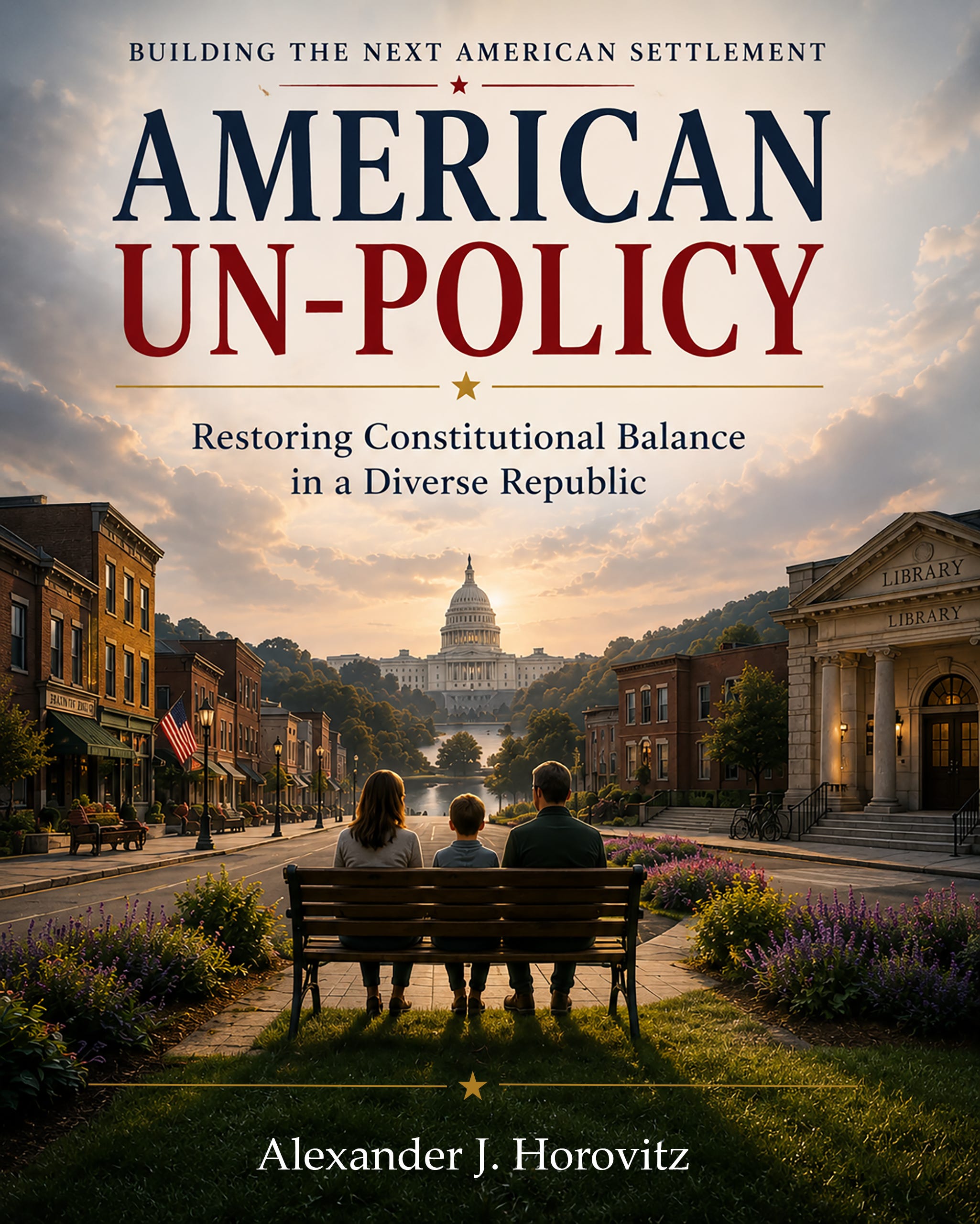
Another Aside: As I argue in a book I am writing for America’s 250th birthday, the country does not need one America to conquer another; it needs many Americas disciplined by one Constitution. I call the argument the American Un-Policy, not because policy is unnecessary, but because our first question should not be, “What program shall Washington design?” It should be, “Where should responsibility live?” The core principle is simple enough to be dangerous: rights are national; flourishing is plural. Equal citizenship, due process, free speech, religious liberty, voting rights, and the basic dignity of persons under law require federal floors strong enough to keep citizens from falling through them. But the forms of human flourishing—schools, families, churches, clinics, unions, neighborhoods, recovery rooms, libraries, local newsrooms, civic associations, and ways of belonging—must remain plural enough for a continental republic to breathe. The tension is permanent: local control can become local tyranny; federal protection can become national moral conquest. The Un-Policy tries to discipline both temptations, preserving a republic in which Americans may disagree about the good life without making every election a permission slip for existence.
An “Un-Policy” answer begins with an unfashionable discipline: put authority where it belongs.
At the federal level, establish floors. Not ideological supervision. Floors. Protect speech. Protect religious liberty. Protect due process. Protect dissent. Require disclosure for paid political persuasion. Require transparency for synthetic media, bot networks, and entities pretending to be local news while operating as partisan laundromats with stock photos. Punish fraud, impersonation, undisclosed foreign influence, and deceptive political advertising. Require large platforms to disclose meaningful information about political ad targeting, recommendation policies, synthetic content practices, and the civic effects of major design changes.
This is conduct regulation, not viewpoint licensing.
The state may say: tell us who paid for the advertisement. It may not say: tell us whether the opinion is sufficiently wholesome. The state may say: do not impersonate a local newspaper. It may not say: the local newspaper must adopt a national theology. The state may say: disclose synthetic media in political persuasion. It may not say: satire must report to a humor tribunal, though one suspects half of Washington would apply to serve.
The floor is transparency, anti-fraud, anti-coercion, and public evidence.
The form must be plural.
And that means rebuilding civic media where people actually live.
Create Civic Media Match grants.
Such an approach would support local journalism, library civic desks, community-college reporting labs, public-records access, school-board and zoning-board coverage, candidate forums, local election guides, civic newsletters, local radio, and public meeting coverage. It would not be a federal content bureau. It would not fund “approved narratives.” It would not invite mayors to purchase flattering watchdogs and then complain about the barking. It would fund the function: local accountability capacity.
The rules would be stern because innocence is not a public policy.
No editorial control by government.
No viewpoint preference.
No partisan eligibility test.
No compelled ideological affirmations.
Transparent funding.
Independent governance.
Public lists of awards.
Firewalls against official retaliation.
Small grants simple enough for local institutions without grant-writing priests.
Complaint channels.
Sunsets.
Audits.
Local match adjusted for poverty, so wealthy suburbs do not collect civic virtue at a discount while poor counties are told to bootstrap their way to a reporter.
The purpose is not to create a national press. We have enough national voices already, many of them apparently paid by the syllable and allergic to proportion. The purpose is to restore address lines to shared reality. A republic cannot rely on national media to tell towns the truth about themselves. National media turn places into examples. Local media, when they work, turn examples back into places.
Shared reality needs an address.
A Public Evidence Layer
The second piece is a public evidence layer.
Not a truth board. Not a censorship office. Not a blue-ribbon panel of people who believe every American problem can be solved by credentialed disappointment. A public evidence layer would make the materials of judgment more available: public records, source provenance, correction histories, synthetic-media labels, sponsorship disclosures, local-document links, ownership transparency, and searchable civic data.
When a claim goes viral about a school, city, budget, crime, election office, or public program, citizens should be able to see the relevant documents without needing a law degree, a day off work, and a cousin in the clerk’s office. Public records should not be a scavenger hunt designed by Kafka’s least efficient nephew. Budgets, meeting minutes, contracts, police policies, school performance data, zoning applications, campaign finance records, and public notices should be accessible, searchable, and written for citizens rather than for institutional self-protection.
The dashboard must be a mirror, not a throne.
That distinction is everything. Metrics can reveal failure; they can also become little tyrants with better colors. The public evidence layer should equip citizens, journalists, parents, local officials, courts, watchdogs, and civic associations with questions. It should not allow Washington to become the sole interpreter of answers.
Show the receipts.
Do not appoint a priesthood.
Platform Civic Impact
The third piece is platform civic impact.
The platforms will protest, as monopolies and near-monopolies always do, that they are neutral vessels, mere pipes, humble facilitators of expression, public squares with advertising departments, victims of both sides, misunderstood engineers tragically burdened by quarterly earnings. This is charming in the way a rhinoceros is charming when it insists it is technically a ballet dancer.
Platforms are not merely speakers. They are distribution architectures. They decide what is recommended, buried, monetized, labeled, throttled, amplified, suggested, autoplayed, and served to the citizen at midnight when judgment has retired and appetite remains on duty.
A serious republic should require major platforms to publish civic-impact statements for significant changes affecting news distribution, political content, local journalism, synthetic media, children, and recommendation systems. The question is not: did the platform permit an opinion we dislike? The question is: what does the design do to civic life?
The same humility should govern identity and anonymity online. A republic should hesitate before requiring every citizen to present papers before speaking; anonymity has protected dissidents, whistleblowers, abuse victims, religious minorities, political heretics, and ordinary Americans who do not care to have every passing opinion stapled to their employment record. But anonymity is not a sacrament for machines. Platforms should not be allowed to shrug when accounts buy political reach, simulate human popularity, impersonate local institutions, operate at industrial scale, or use automation to counterfeit public sentiment. The ordinary citizen should not need a passport to argue badly on the internet. The entity purchasing persuasion or manufacturing a crowd should be made legible. Protect anonymous speech; expose synthetic power.
Does it bury local news beneath national rage?
Does it reward anonymous provocation over accountable reporting?
Does it make correction less visible than accusation?
Does it amplify synthetic media faster than provenance can follow?
Does it turn young people into political subjects before they are citizens?
Does it monetize civic corrosion and then issue a statement about community standards?
Again: no Ministry of Truth. No viewpoint licensing. No government script. Just disclosure, auditability, and civic consequence made visible.
If platforms wish to be the roads on which democratic information travels, they may endure the indignity of a traffic report.
Permissionless Repair
The fourth piece is permissionless experimentation.
Let states, cities, counties, tribes, libraries, community colleges, civic associations, local newsrooms, religious institutions, secular nonprofits, unions, and philanthropies try different models of civic information repair under common floors. One town may build a library-based civic desk. Another may support a community college reporting corps. A rural county may need local radio and public-records assistance. An immigrant neighborhood may need translation networks and trusted messengers. A tribal community may need language-preserving civic media. A postindustrial city may need school-board coverage, addiction reporting, and a newsroom that can explain why the hospital merger matters before the emergency room closes.
Let them differ.
But do not waive rights. Do not fund propaganda. Do not bless local censorship. Do not allow public money to become a partisan prize. Do not let philanthropy conduct experiments on poor communities in the dark. Do not let government support turn local journalism into municipal stenography. Do not let every successful local model become the next federal template, as though Washington cannot see a good garden without paving it into a program.
The principle may travel.
The recipe may not.
The Concrete Proposal
Here, then, is the concrete proposal: a Public Reality and Civic Media Act.
Its first title creates a transparency floor: disclosure for paid political advocacy, synthetic political media, major bot networks, foreign-backed influence efforts, political ad targeting, and fake local-news operations.
Its second title creates Civic Media Match: viewpoint-neutral support for local journalism, library civic desks, community-college reporting labs, public-record access, local election guides, school-board and zoning-board coverage, and civic forums, with strict firewalls against editorial control.
Its third title creates the public evidence layer: searchable public records, correction visibility, provenance standards, document-linked civic claims, and plain-language access to public decisions.
Its fourth title requires platform civic-impact statements for major algorithmic and policy changes affecting news, political persuasion, synthetic media, local journalism, and minors.
Its fifth title authorizes local civic media experiments under national floors: free speech, due process, viewpoint neutrality, anti-coercion, transparency, public accounting, independent review, and sunset clauses.
What this does not do is just as important.
It does not revive the Fairness Doctrine.
It does not command balance.
It does not regulate opinion.
It does not make government the arbiter of truth.
It does not treat citizens as children awaiting informational nutrition from Washington’s ladle.
It does not pretend that neutrality means moral emptiness.
It does not ask every civic institution to speak in the accent of the ruling coalition.
It says: protect speech, expose manipulation, fund local reality, rebuild civic rooms, discipline platforms with transparency, and let communities experiment under rights.
After Fairness
The Fairness Doctrine tried to make broadcasters behave fairly.
That world is gone.
The modern task is not to make every voice fair. It is to make no single voice, platform, faction, billionaire, bureaucracy, influencer, or algorithm powerful enough to counterfeit the public square.
A republic worthy of free citizens should not fear speech. It should fear citizens so isolated from local reality that speech becomes sorcery. It should fear a country where the school board is unknown, the local paper is dead, the library hours are cut, the public records are hidden, the platform is opaque, the influencer is trusted because he seems authentic, and the citizen knows everything about national betrayal and nothing about the zoning meeting down the street.
The antidote to disembodied faction is not moderation training.
It is embodied citizenship.
Open the rooms. Fund the local record. Show the receipts. Protect the dissenter. Expose the sponsor. Label the synthetic fraud. Publish the public business. Let the town argue about itself before the nation weaponizes it. Give citizens institutions close enough to touch and strong enough to contradict the feed.
Our nation does not need a Ministry of Fairness.
We need thousands more places where reality has an address.